Accounting, Tax, and Finance Essentials for Executives Assigned to the U.S.
Part 2: Why Can a Profitable Company Be Short on Cash?
You review your company’s performance reports and see a profit on the income statement. Yet the bank balance has not grown as much as you expected. In some cases, it has declined.
This situation can be puzzling when you take on a management role at a U.S. subsidiary.
“If we are making a profit, why don’t we have the cash?”
The reason is simple.
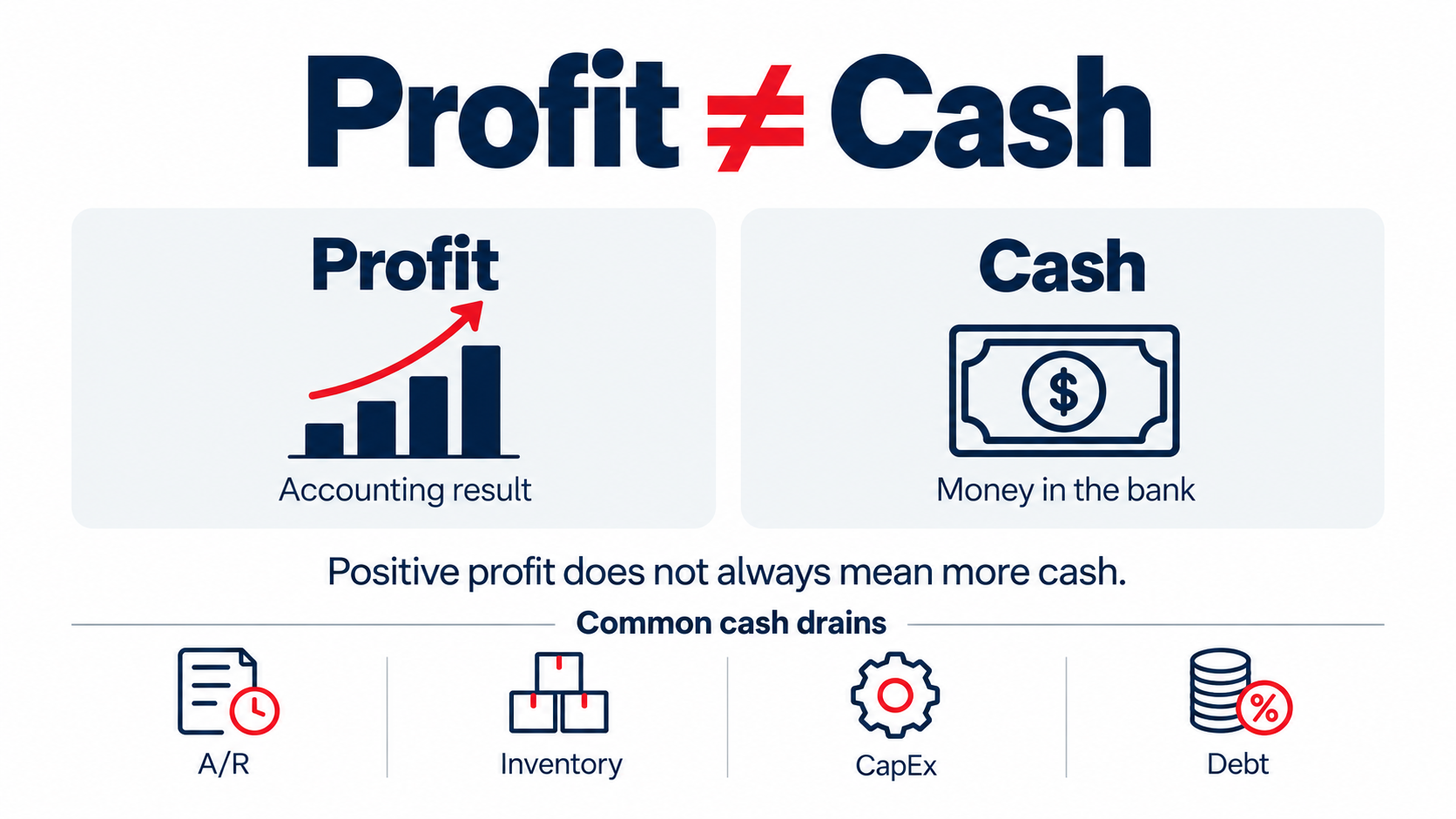
Profit and cash are not the same thing.
In this article, we will use concrete examples to explain why cash may not increase even when a company is profitable.
1.Profit Is an Accounting Result; Cash Reflects Actual Money Movements
The first point to understand is that profit and cash measure different things.
Profits are calculated by subtracting expenses from revenue for a given period.
For example:
- Revenue: $1,000,000
- Expenses: $900,000
The resulting profit is $100,000.
Cash, on the other hand, reflects the money actually received and paid out of the company’s bank accounts. In accounting, revenue and expenses are not necessarily recognized at the same time as the related cash receipts or payments.
That means:
A profit of $100,000 does not necessarily mean a $100,000 increase in cash.
2.The Most Common Reason: Accounts Receivable
Suppose a company sells $1,000,000 worth of products this year.
If the revenue recognition criteria are met, the company records $1,000,000 in revenue.
However, if it has collected only $600,000 from customers, the remaining $400,000 stays on the balance sheet as accounts receivable.
In this case:
Revenue on the income statement: $1,000,000
Cash received: $600,000
Recording revenue does not increase cash for the portion that has not yet been collected. As a result, companies with growing sales often see accounts receivable rise at the same time. If sales are strong but cash is not increasing, one of the first things to check is the change in accounts receivable.
3.An Increase in Inventory Can Also Reduce Cash
The next important item is inventory.
Suppose the company purchases $300,000 worth of products this year in anticipation of higher sales next period.
It pays $300,000 in cash to buy the products.
However, if those products have not yet been sold, their full cost is not immediately recognized as an expense.
In many cases, the products are recorded as inventory and asset on the balance sheet.
In other words:
- Cash decreases by $300,000.
- The $300,000 has not yet been recognized as an expense.
- Inventory increases by $300,000.
Even if profit on the income statement, or P&L, remains steady; investment in inventory may be reducing cash. This deserves particular attention in manufacturing and wholesale businesses, where inventory growth can have a significant effect on cash flow.
4.Capital Expenditures Reduce Cash Before the Full Expense Is Recognized
Capital expenditures are another common source of differences between profit and cash.
Suppose the company buys a new machine for $500,000 and pays in cash. Cash decreases by $500,000 at that point.
For accounting purposes, however, if the machine is used for five years, the company generally does not expense the entire $500,000 when it is purchased. Instead, it records a fixed asset and recognizes the cost as depreciation expense over several years.
Using a simplified example of $100,000 in depreciation each year:
This year’s cash flow impact: −$500,000
This year’s income statement impact: only $100,000 in depreciation expense
For this reason, a company that makes a major capital investment may see cash decrease substantially even while it is profitable.
5.Loan Repayments Are Not Fully Reflected in Profit
Another often-overlooked item is loan repayment.
Suppose the company makes a $200,000 payment on a bank loan.
Cash decreases by $200,000.
However, the portion of that $200,000 that repays principal is generally not an expense on the P&L.
It simply reduces debt on the balance sheet. The interest portion, on the other hand, is reflected as an expense on the income statement.
Repaying a loan reduces cash, but the full payment is not an expense.
This is another major reason why profit and cash do not match.
6.A Numerical Example
Suppose a company reports a profit of $200,000 for the year.
During the same period, the following also occur:
- Accounts receivable increase by $150,000.
- Inventory increases by $100,000.
- The company purchases $120,000 of equipment.
- The company repays $80,000 of loan principal.
In a simplified calculation, even with a profit of $200,000:
$200,000 − $150,000 − $100,000 − $120,000 − $80,000 = −$250,000
Cash could actually decline significantly—in this case, by $250,000.
Of course, an actual cash flow calculation takes other items into account. The key point is:
Earning a profit and increasing cash are two different things.
7.What Should Management Check?
What should managers look for when reviewing monthly financial statements?
Start with the following items.
Accounts Receivable
- Has the balance increased from the previous month?
- Are the receivables aging profile deteriorating?
- Are receivables in the over-90-day aging category increasing?
Inventory
- Is inventory growing faster than sales?
- Is slow-moving or obsolete inventory increasing?
Capital Expenditures (Spending to Acquire Fixed Assets)
- Are any major capital investments planned?
- Have they been included in the budget?
Debt
- What is the principal repayment schedule?
- Can future cash flow comfortably cover the repayments?
In short, it is important to review both the balance sheet and cash flow, not just the income statement.
Management Takeaway
There are three key points to remember:
- Profits and cash are not the same. Accounting profit does not necessarily match the actual increase or decrease in cash.
- Accounts receivable, inventory, capital expenditures, and debt repayments can have a major impact on cash. Even when the P&L looks strong, increases in these items may reduce cash.
- Management should not rely on the income statement alone. Make it a habit to review the balance sheet and cash flow together with the income statement.
Next Article
In the next article, we will explore:
“What should you look for in the balance sheet, income statement, and cash flow statement?”
We will explain the essentials of reading these three financial statements that every manager of a U.S. subsidiary should understand.
※This article is intended as general information only and does not constitute professional advice. Using this document or any other material provided by Premier Kaikei LLP, Premier does not create a professional-client relationship. All information should be independently verified before being relied on or acted upon. Please speak to an experienced professional for case-specific questions.