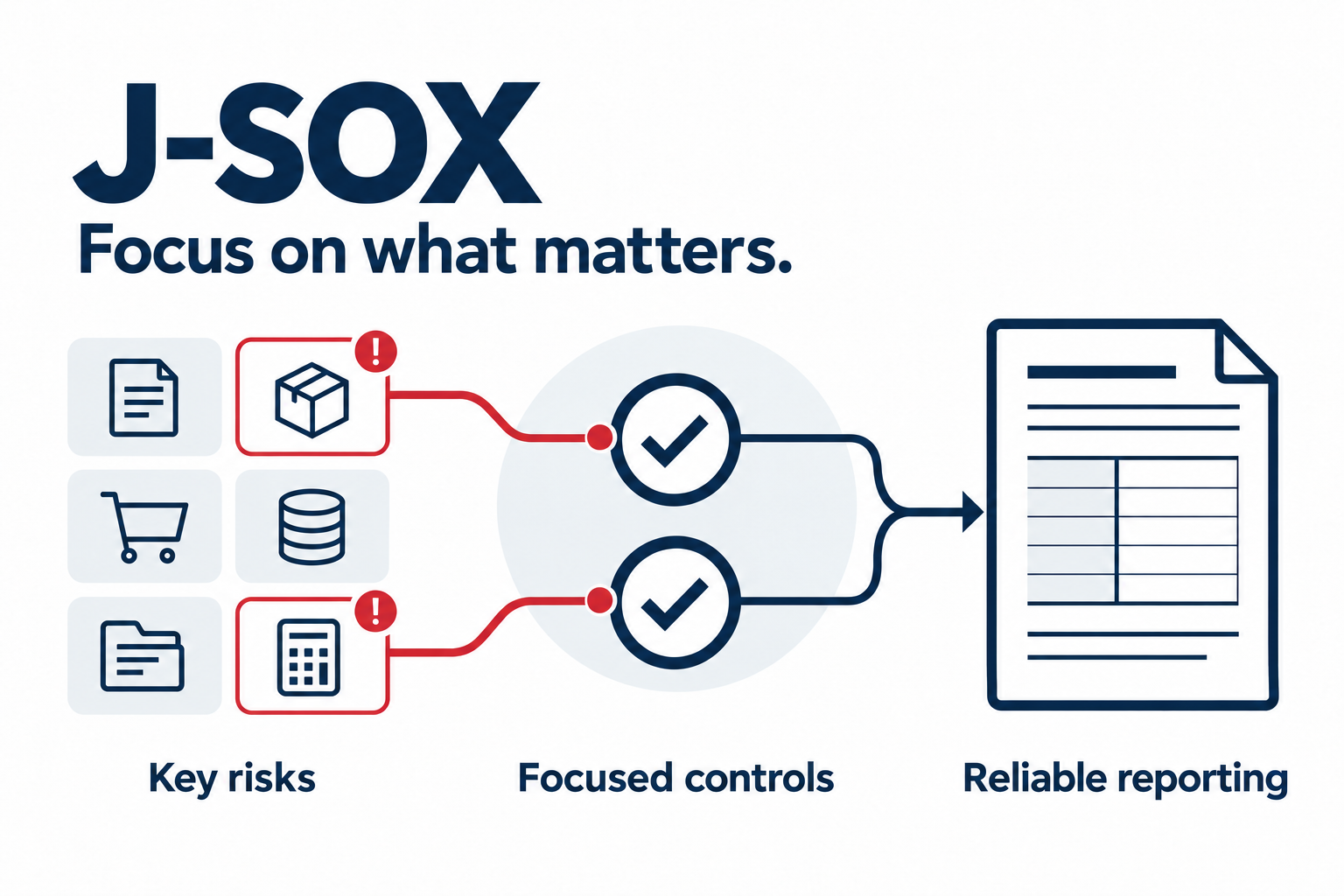
What Is J-SOX? A Simple Guide
“I’ve heard we’re going to start working on J-SOX compliance, but honestly, I’m not sure what it means…”
If that sounds familiar, you’re not alone. In this article, we’ll explain the basics of J-SOX in simple terms.
What Is J-SOX?
J-SOX is Japan’s set of rules on the internal controls that help publicly listed companies prepare reliable financial reports.
The basic process is straightforward. First, management assesses whether the company’s internal controls are working effectively and summarizes the results in a report. An external auditor then examines whether that report appropriately presents management’s assessment.
“Financial reporting” includes more than financial statements. It also includes disclosures that significantly affect the reliability of those reports. The scope extends beyond the parent company to include subsidiaries and companies accounted for using the equity method.
Internal Control Does More Than Prevent Fraud
When people hear “internal control,” they often think of fraud prevention. But internal control serves several broader purposes:
- Making financial reporting reliable.
- Complying with laws and regulations.
- Safeguarding company assets.
- Helping business operations run effectively and efficiently.
The Six Basic Elements of Internal Control
Internal control consists of the following six elements:
- Control environment: Management’s attitude and the company’s culture, which form the foundation for all internal controls.
- Risk assessment and response: Identifying what could go wrong and preparing for it.
- Control activities: Everyday checks, such as approvals, reconciliations, and segregation of duties.
- Information and communication: Ensuring that accurate information reaches the right people at the right time.
- Monitoring: Checking that internal controls continue to work as intended.
- IT considerations: Addressing risks related to systems and data.
Today, nearly every business process depends on technology. That makes IT an essential element that connects with all five of the others.
You Don’t Have to Make Everything Perfect
This is the most important point: J-SOX does not require detailed documentation of every business activity or the elimination of all risk.
The goal is to provide reasonable assurance, meaning a reasonable level of confidence in the reliability of financial reporting.
To achieve this, J-SOX uses a top-down, risk-based approach. Start by looking at the financial statements as a whole, narrow the focus to significant accounts and business processes, and concentrate your efforts on higher-risk areas.
Four Questions to Ask
For each business process, consider these four questions:
- What could go wrong?
- Could it cause a significant error in our financial statements?
- Do we have controls to prevent or detect it?
- Are those controls properly designed, and do they actually work in practice?
Common examples of things that could go wrong include recording revenue in the wrong period, placing orders without approval, discrepancies in inventory quantities or valuation, and inappropriate access to systems.
Common Examples of Controls
- Sales: Customer order approvals, credit checks, accurate invoicing, and recording revenue in the correct reporting period.
- Purchasing: Purchase order approvals and three-way matching of purchase orders, receiving records, and invoices.
- Inventory: Reconciling physical inventory counts to accounting records, checking inventory valuation, and managing inventory receipts, shipments, and storage.
- IT general controls: Access management, change management, and IT operations management. These controls provide a foundation for all business processes.
Documentation: The Three Core Documents
Three documents commonly used in J-SOX are:
- Flowchart: A visual map of how transactions move through a business process.
- Process narrative: A written explanation of who does what and which systems they use.
- Risk and Control Matrix (RCM): A table that links risks to the controls designed to address them.
The overall process generally follows these steps:
- Define the scope.
- Perform walkthroughs to confirm how processes and controls work.
- Document the processes and controls.
- Test whether the controls are operating effectively.
- Address identified issues and reach a conclusion.
Final Thoughts
J-SOX is often viewed as “preparing paperwork for an audit.” In practice, it is a way to make the risks in your business processes visible and focus your efforts where they matter most.
Start with your financial statements, work backward, and focus first on the areas where an error would matter most.
※This article is intended as general information only and does not constitute professional advice. Using this document or any other material provided by Premier Kaikei LLP, Premier does not create a professional-client relationship. All information should be independently verified before being relied on or acted upon. Please speak to an experienced professional for case-specific questions.
