A Democratic Congress: Possible Implications for Japanese Businesses in the U.S.
Updated November 12, 2026
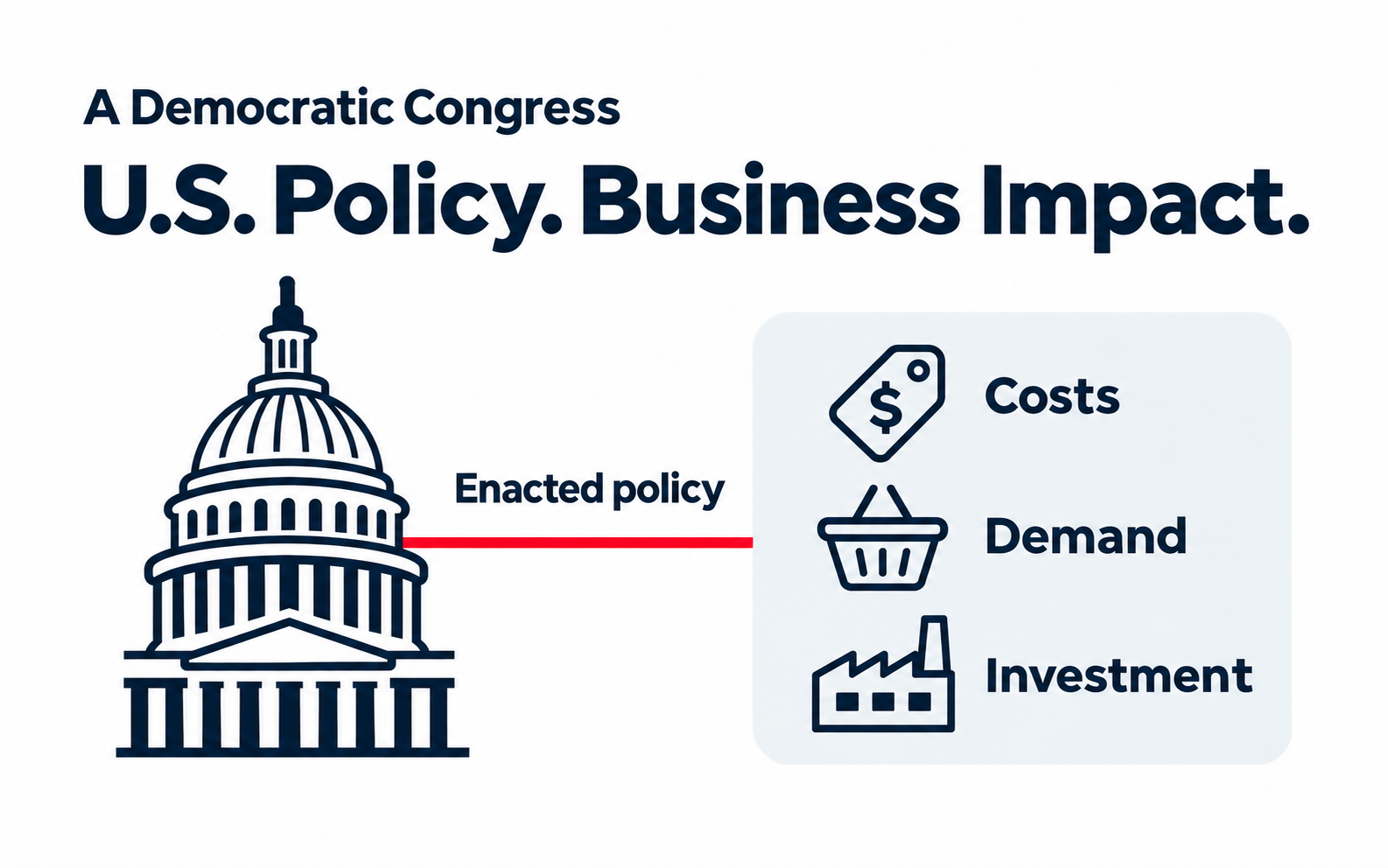
For Japanese businesses in the United States, the key question is not simply who controls Congress, but which policy changes can actually be delivered—and how they affect costs, customers and investment plans. Democrats’ victories in both chambers in the November 3, 2026, midterm elections set the stage for divided government. Our assessment is that selective compromises and periods of political uncertainty are more likely than an immediate reset of U.S. economic policy.
What changes—and what does not
Democrats will control Congress beginning in January 2027, while President Trump remains in the White House. Congress can approve or block legislation, negotiate government funding and scrutinize administration policies. The president retains his veto and continues to oversee executive agencies.
House Democratic Leader Hakeem Jeffries’s November 4, 2026, agenda centers on household costs, including healthcare, housing, groceries and energy. That focus could bring more scrutiny of policies affecting household budgets.
Tariffs and operating costs
Tariffs are one of the most direct business considerations. Jeffries’s agenda calls for reversing the administration’s tariffs, but existing duties remain in place unless changed through the relevant legal process. Japanese companies importing vehicles, machinery, food or components would benefit if applicable duties were reduced. Companies manufacturing in America could also benefit on imported inputs, although cheaper competing imports could put pressure on their selling prices.
In a hypothetical example, a five-percentage-point tariff reduction on $20 million of annual imports would reduce gross duties by $1 million, assuming unchanged import values and volumes. How much becomes additional profit depends on whether suppliers adjust prices and customers expect a discount. The same policy can therefore affect an importer and a local manufacturer differently.
Consumer demand and financing
U.S. consumer spending is another important factor. For food companies, retailers and restaurants, the amount households have left after paying for housing, groceries and healthcare can matter more than the election result itself. Policies that ease household costs could support demand. Persistent inflation could leave consumers cautious even if the economy continues growing. For industrial suppliers, customers’ willingness to invest in factories, equipment and inventory will be equally important.
Labor policy can affect both sides of this equation. Higher wages can increase a company’s operating costs while giving households more money to spend. Debates over employee benefits, labor protections and immigration also matter because they can influence the cost and availability of workers. State and local requirements remain important alongside federal policy, so Japanese businesses in different parts of America may experience quite different conditions.
Borrowing costs will influence both customer demand and investment opportunities. Lower interest rates could make vehicle purchases, equipment financing and acquisitions more affordable. Persistent inflation could keep financing expensive. The Federal Reserve, America’s central bank, makes monetary policy decisions with operational independence from elected officials. A Democratic majority in Congress therefore does not automatically mean lower interest rates or a particular direction for financial markets.
Agreement on infrastructure or industrial investment could create orders for Japanese suppliers or incentives for U.S. operations in semiconductors, batteries and energy. Benefits would depend on enacted funding, eligibility requirements and implementation. A funding standoff that interrupts federal operations could affect companies involved in government projects or dependent on certain federal services.
Implications for Japanese parent companies
The implications for Japan extend beyond shipments to the United States. Strong U.S. demand supports Japanese exporters and their suppliers. Weaker demand can reduce orders and investment in Japan. Meanwhile, incentives to produce in America could encourage Japanese companies to expand U.S. capacity. That may strengthen their access to American customers while changing how much production, employment and supplier spending remain in Japan.
The dollar–yen exchange rate adds another layer. A stronger yen generally makes dollar-priced acquisitions and imports cheaper for Japanese buyers but reduces the yen value of U.S. profits. A weaker yen tends to have the opposite effects. Even if a U.S. subsidiary’s dollar earnings are unchanged, its contribution to the parent company’s reported yen earnings can move significantly. Actual exposure depends on hedging and where costs and revenues arise. Interest-rate differences, central-bank decisions and global economic conditions will influence the exchange rate.
U.S.–China relations and international events remain important X factors. Japanese companies with suppliers or customers in China may be affected by restrictions on technology exports and changes in sourcing requirements. A change in congressional control should not be assumed to remove those issues. Energy prices, shipping disruptions and geopolitical tensions can also raise costs in both America and Japan, potentially outweighing the effect of individual congressional decisions.
What Executives Should Watch
Before changing investment plans, executives should answer three questions.
- Which products and inputs are most exposed to tariff changes, and how would relief affect margins and competitive pricing?
- How would different demand and dollar–yen scenarios affect U.S. earnings and their value to the Japanese parent company?
- Which enacted policies or funding decisions—not just proposals—would justify changing the investment plan?
※This article is intended as general information only and does not constitute professional advice. Using this document or any other material provided by Premier Kaikei LLP, Premier does not create a professional-client relationship. All information should be independently verified before being relied on or acted upon. Please speak to an experienced professional for case-specific questions.