How Investing in People Strengthens US Operations
Lessons from Premier Kaikei for Japanese companies building and managing US teams
By Hidehito “Jake” Kanai
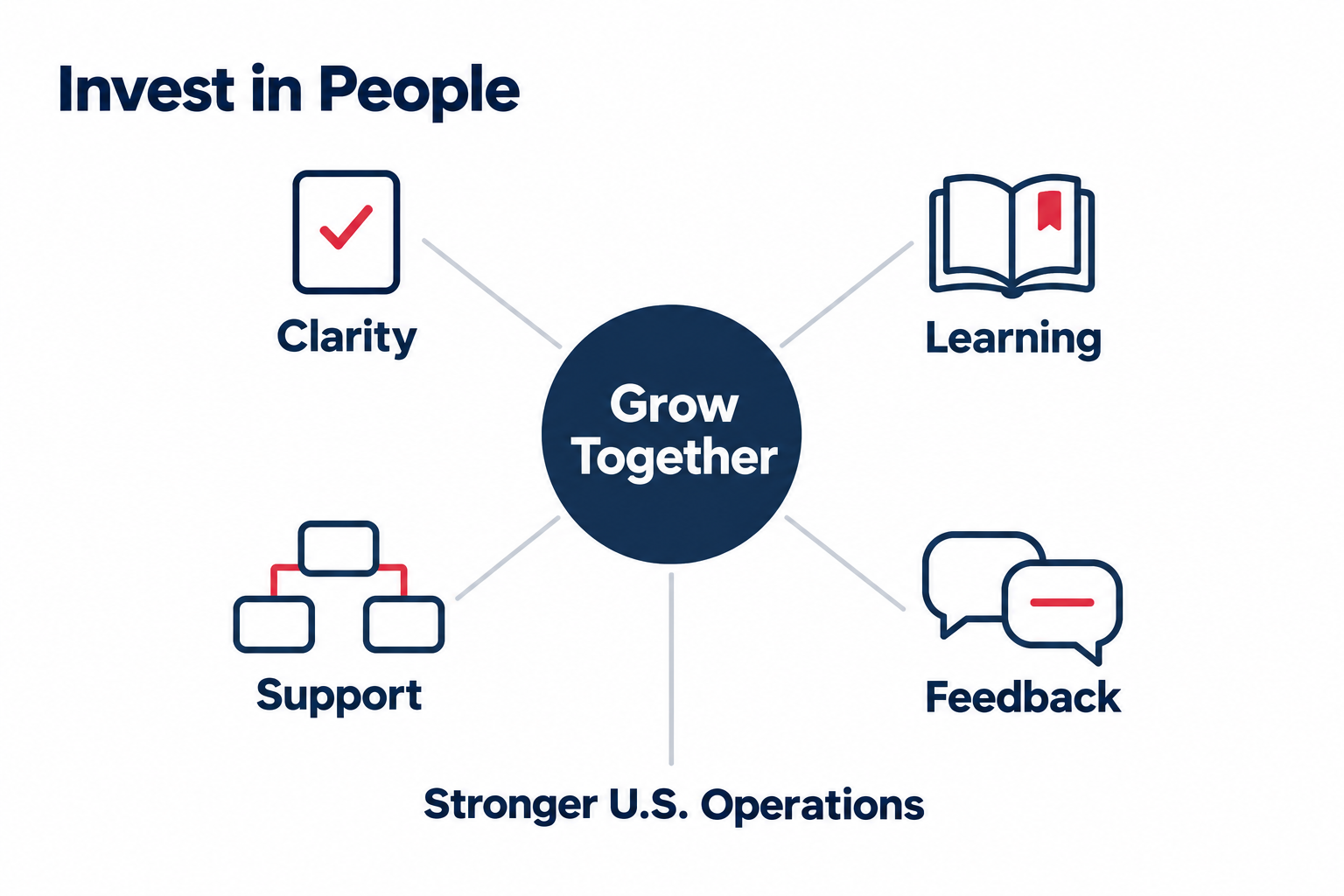
For a Japanese company opening its first U.S. office or strengthening an established subsidiary, building an effective team deserves a place alongside the business plan and financial budget. People need to understand what success looks like, how decisions will be made, and where to turn when an issue arises. Leaders need to understand what enables those people to contribute and grow.
These questions are familiar to us at Premier Kaikei. As PK has continued to grow, we have invested in communication, learning, and leadership support. Our progress reflects the dedication of our colleagues and the trust of our clients. It has also reminded us that the way a firm supports its people influences the service it can provide.
The examples below come from PK’s experience. They offer practical ideas for Japanese headquarters, U.S. subsidiary leaders, and companies preparing to enter the market. We continue to refine our approach, and I hope sharing it encourages a useful exchange of ideas.
Make expectations clear across borders
Employees bring different experiences, strengths, career goals, and responsibilities outside work. Leaders should understand those differences and agree on clear expectations. Language ability alone does not establish a shared understanding of priorities, decision authority, or how to communicate a concern.
At PK, monthly town halls give us an opportunity to share updates, discuss our direction, and invite questions. They help connect individual assignments with the firm’s broader purpose. Gallup’s research emphasizes meaningful conversations about recognition, working relationships, goals, and strengths. [1] Scheduled meetings provide a foundation, alongside everyday feedback and individual discussion.
For a Japanese company establishing a U.S. operation, a useful starting point is to document who can decide what locally, which matters require headquarters approval, and how urgent issues should be escalated. In an existing subsidiary, ask whether employees and headquarters would describe those arrangements in the same way. A regular forum can expose differences in understanding before they disrupt work.
Make learning part of how the team works
Our monthly PK Cafe study sessions create space to exchange knowledge and learn from one another. Collective training sessions throughout the year provide further opportunities to develop technical skills and professional judgment. These efforts depend on colleagues being willing to share what they know, ask thoughtful questions, and support someone else’s development.
For clients, the purpose is practical: a team better equipped to explain an issue, recognize when specialist input is needed, and provide useful guidance. Research by Teresa Amabile and Steven Kramer highlights the importance of progress in meaningful work. [2] Recognizing a skill learned or a process improved helps people see how their development makes a difference.
The lesson for a U.S. business is to give learning a place in the operating schedule. A small office could start with a short monthly session on a recurring issue and record the agreed process in a shared guide. Pairing colleagues with complementary skills and developing backup coverage can also reduce dependence on a single person. This is especially useful where a role combines technical knowledge, Japanese communication, and local operating experience.
Bring the client and operating perspective into the discussion
The addition of PK’s bilingual and bicultural Chief Administrative Officer has brought valuable experience from working within businesses outside public accounting. Her perspective complements our team’s accounting expertise by helping us consider how advice is received and implemented within a client’s organization.
A technically sound recommendation becomes more useful when it considers the people, time, and systems available to carry it out. For example, advice on improving a monthly close should consider who owns each task, where information comes from, and how the process will work when a key employee is away. This is the kind of practical understanding we want to deepen across PK.
For Japanese headquarters and U.S. leaders, the same principle applies when introducing policies or processes. Discuss the desired outcome with the people responsible for implementation. Ask what support they need, which assumptions may not fit local operations, and how progress will be assessed. Invite input based on each person’s experience rather than assuming that everyone from the same country shares the same perspective.
Give managers a regular way to coordinate and resolve issues
At PK, partners meet with key management personnel every two weeks to share observations, coordinate priorities, and discuss where teams need support. These conversations create an opportunity to identify concerns early and connect decisions across assignments.
For a U.S. subsidiary, a similar meeting can focus on a few concrete questions: What is putting delivery at risk? Where is capacity stretched? What decision is needed from headquarters? Who will act, and by when? The meeting becomes useful when decisions and responsibilities are recorded and followed through.
Leaders also need people to feel comfortable raising concerns. Amy Edmondson’s work emphasizes that candid discussion and high professional standards can coexist. [3] An employee who identifies an unclear instruction or flags a potential problem is contributing to a better result. The response from management helps determine whether others will speak up next time.
Build relationships and recognize different contributions
Training and social events throughout the year give PK colleagues opportunities to build relationships beyond their immediate assignments. Together with our regular forums, these efforts have helped make the firm a more positive place to work. We value the contributions that make this possible, including patient coaching, dependable follow-through, and the everyday assistance colleagues give one another.
For leaders of Japanese businesses in the United States, it is useful to recognize the full range of work that supports the operation. Some people strengthen technical quality; others improve a process, develop colleagues, or build client relationships. Career conversations should help each person understand how their strengths can develop and what broader responsibilities require.
The practical question is whether employees can see a connection between their contribution, the support they receive, and their future in the organization. Asking that question regularly gives leadership a better basis for action than assuming that everyone is motivated in the same way.
Start with a few practices and improve them together
A company opening a U.S. office can establish clear responsibilities, a regular headquarters dialogue, and a simple learning routine from the outset. An established subsidiary can review where its current arrangements leave people waiting for decisions, repeating work, or depending too heavily on one colleague. Choose a few improvements, involve the team in designing them, and review whether they are helping.
At PK, our goal is to help clients manage their U.S. businesses with greater confidence through sound accounting, financial discipline, and practical support. Investing in our colleagues is part of our responsibility to make that goal achievable. Leadership must provide clear priorities, useful training, and room for people to share what they see in their work.
We, the partners at PK, are not perfect. We have received criticism from employees and have experienced some turnover. We respect the perspectives shared with us and take them seriously, even when they are difficult to hear. These experiences remind us to examine our own leadership and where we can do better. We want to grow collectively, with colleagues helping shape the firm and partners continuing to learn how to support them. Our responsibility is to listen, reflect, and translate feedback into thoughtful improvements.
To our PK colleagues: your expertise, care, and willingness to help one another are central to the firm we are building. We welcome an open forum, including perspectives that differ from our own. Help us understand how we can better support you and how we can improve together. You do not need a fully developed solution before raising a question or concern.
To our clients and fellow business leaders: we welcome the same exchange. What has helped your people succeed in the United States? The more openly we share our experiences and learn from our teams, the better prepared we will be to build businesses that serve their clients well and give their people opportunities to grow.
Sources and further reading
[1] Gallup. A Great Manager’s Most Important Habit. May 29, 2023; page updated February 16, 2026.
[2] Harvard Business School Working Knowledge. How Small Wins Unleash Creativity. September 6, 2011. Teresa Amabile discusses her research with Steven Kramer.
[3] Harvard Business School. Leading in Tough Times. November 22, 2022. Amy Edmondson on psychological safety and accountability.
※This article is intended as general information only and does not constitute professional advice. Using this document or any other material provided by Premier Kaikei LLP, Premier does not create a professional-client relationship. All information should be independently verified before being relied on or acted upon. Please speak to an experienced professional for case-specific questions.